How should a growing SME use AI?
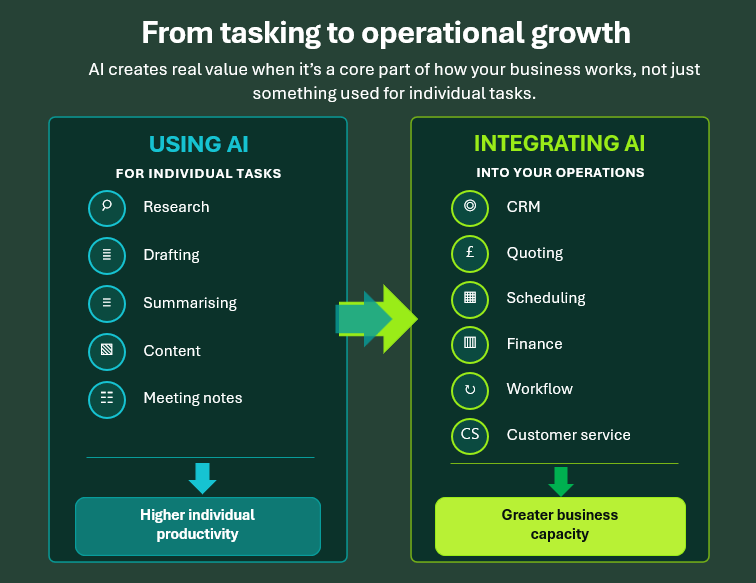
AI can create more value when it is integrated into the systems and processes that run the business, rather than used only for isolated tasks. Embedding AI into CRM, quoting, scheduling, finance and workflow can increase the amount of activity the existing organisation is able to support. UK data shows that although 51% of small businesses handling digitised data use AI, only 31% of those users have integrated it into their existing business systems.
The Financial Times reported this week on Chinese restaurant groups including Haidilao and Yum China using AI across scheduling, inventory management, food safety, delivery logistics and restaurant operations. Haidilao is using video analysis to manage table turnover alongside automation in kitchens and stock management. Its overseas operation increased its operating margin from 6.4% to 10.7%, while Yum China has recorded nine consecutive quarters of margin improvement. The FT does not attribute those results to AI alone, but places the technology within a broader programme to improve the economics of each site.
For SME owners, the useful comparison is where these companies are applying the technology. AI is being built into the processes that determine how much business the operation can handle.
Among UK small businesses handling digitised data, 51% already use AI. Among small businesses using it, however, only 31% have integrated AI into their existing business systems, compared with 57% of large businesses. The UK Business Data Survey defines integration as AI embedded within systems such as CRM, finance, workflow and productivity platforms.
Much of the AI being used by SMEs therefore remains outside the operating structure of the business. Someone researches a subject, drafts an email, summarises a document or creates content with AI, while quoting, scheduling, customer administration, finance and workflow continue much as before.
OECD research among more than 5,000 SMEs found a similar pattern. Only 29% of SMEs using generative AI were applying it to the core activities of the company; use was more common for simple or one-off tasks than for complex and recurring work.
Why integration has more leverage in an SME
Capacity is scarce in a growing SME. Customer administration may be carried out by somebody who also manages accounts. The owner may still prepare quotations or approve pricing. Salespeople may enter information into the CRM manually after meetings, while data passes repeatedly between spreadsheets, finance software and project-management systems.
Five hours released from a team of five represents 2.5% of the team's working week. Those hours may also belong to the person currently restricting how much new business the company can manage.
The opportunity becomes larger as transaction volumes rise. Producing ten quotations manually each month may create little pressure; producing 100 can consume a substantial amount of commercial time. Customer onboarding, scheduling, reporting and routine enquiries behave in much the same way. Growth increases the volume passing through these processes, so relatively small inefficiencies begin consuming more people and more margin.
The OECD survey gives some indication of the commercial effects SMEs are beginning to report. Among generative-AI users, 35% said it had helped them scale, 29% said it helped them compete with larger companies and 26% reported increased revenue. Among businesses experiencing skills gaps, 39% said generative AI had helped compensate for them. These are reported experiences rather than independently measured financial returns, but they show where SMEs are finding value.
Build AI into the work, not around it
Integrating AI does not mean automating every process. Poor processes remain poor processes when technology is added to them. The stronger candidates are usually the places where information is repeatedly entered, transferred, checked or recreated; where work waits for one particular person; or where customer growth is creating a faster increase in administration.
This is one of the practical differences between an early business and a growth business. In the earlier stage, improving the productivity of one person can remove a meaningful amount of pressure. As volumes rise and more people become involved, capability increasingly depends on how the organisation moves information, makes decisions and processes work.
The restaurant groups in the FT article are operating at enormous scale, but the principle appears much earlier. For an SME, integrating AI into the systems that run the business can increase the amount of growth the existing organisation is capable of supporting.
Sources
Financial Times, Chinese restaurant chains put AI on the menu, 16 September 2026.
UK Government, UK Business Data Survey 2026.
OECD, Generative AI and the SME Workforce, 2025.
The Business of Growth looks at the differences between running an early business and building a growth business, using current business reporting, evidence and practical models to examine what changes as an SME develops.