
What capabilities are associated with high-growth founders?
Research points to a combination of strong market knowledge, practical execution capability and growth ambition, supported by the management discipline to build capability around the founder. As the business scales, delegation and strategic leadership become increasingly important because sustainable growth depends on the organisation becoming progressively less dependent on one person. None of these characteristics guarantees high growth, but together they provide a useful way of assessing where a founder — and the organisation around them — may need to develop.
Around 71% of UK SME employers* say they aim to grow sales over the next three years. An intention to grow is widespread. Achieving a period of exceptional growth is much rarer. Success depends on the founder’s capabilities alongside their ability to build an organisation that becomes progressively less dependent on them.
Our recent review of research into founders and high-growth businesses points towards a collection of characteristics that appear repeatedly: strong knowledge of the market, practical capability, confidence to execute, ambitious growth intentions, willingness to challenge your own assumptions, management discipline, the ability to build a complementary team and, eventually, the ability to delegate and move away from day-to-day execution.
It would be an unusual person who was equally strong in all of these.
The founder who starts the business isn't quite the founder who scales it
In the early stages, much of what makes a founder effective is intensely personal. You understand the customer and the market, recognise an opportunity, make decisions quickly and have sufficient confidence in your own judgement to act while other people may still be considering the options.
Growth gradually changes how a business must operate. As the organisation expands, the founder can no longer remain close to every customer, decision and aspect of delivery. Knowledge once held largely in one person’s head must be embedded across the business, enabling others to decide and act without repeatedly turning to the founder. The capabilities that created momentum remain valuable, but they increasingly need to be reinforced by capabilities across the organisation.
Our research-informed High-Growth Founder Model brings the findings into eight key areas as a capability framework.
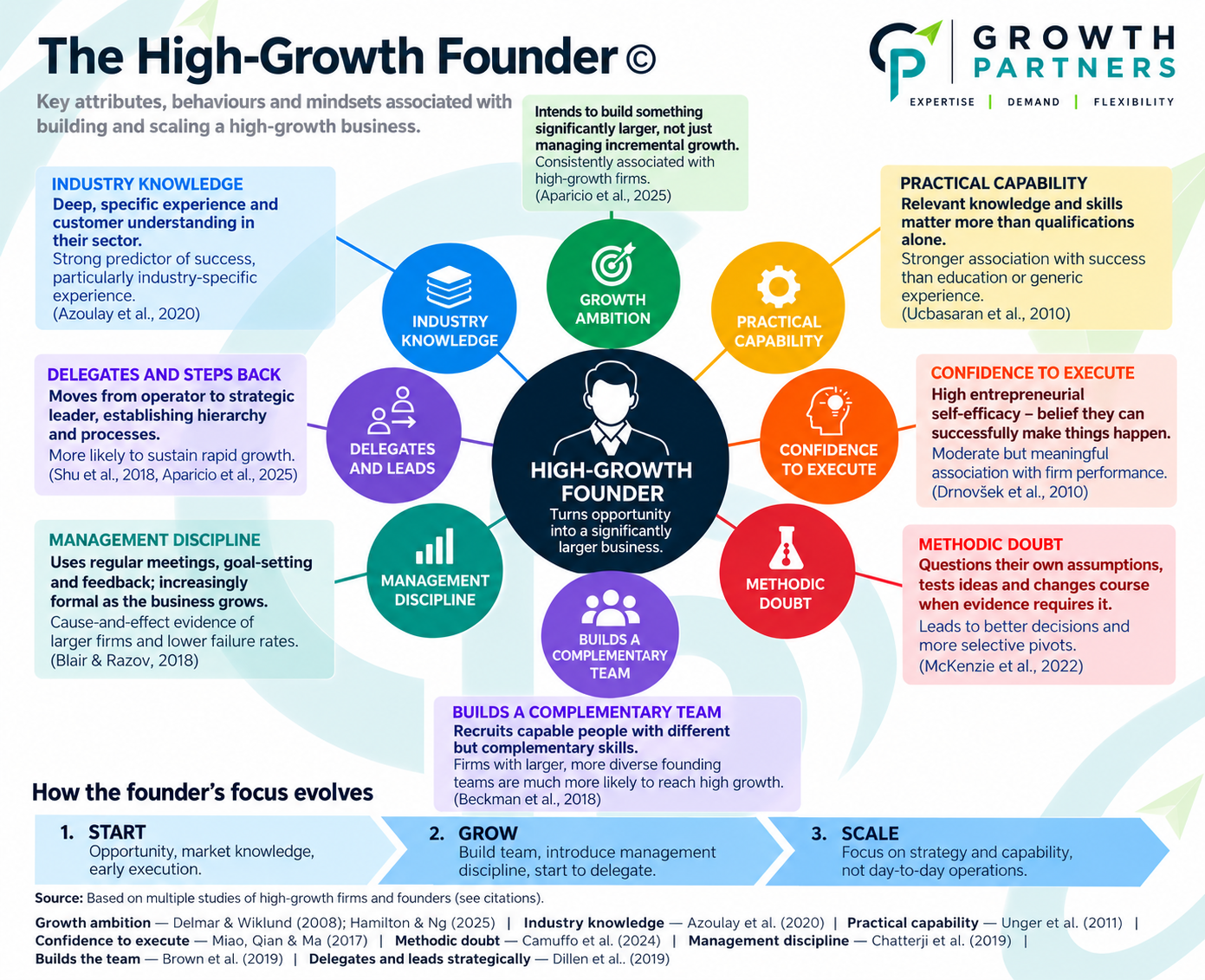
None of these characteristics guarantees high growth. The model is better used as a way of understanding how the demands on the founder and the organisation begin to change as a business develops.
Growth requires more organisation around the founder
ONS research shows that companies employing 10–19 people had an average management score of 0.51, rising to 0.58 for those employing 20–49 people and 0.68 for businesses with more than 250 employees. The difference remained substantial even after the ONS controlled for characteristics including industry, productivity and age.
The ONS data shows that larger businesses tend to use more structured management practices. Even after allowing for differences such as industry, productivity and age, the largest firms still recorded significantly higher management scores than the smallest firms surveyed.
As a business grows, more of what once happened informally has to become deliberate and visible. The organisation can no longer depend on the founder being close enough to everything to keep it moving; it needs clearer ways of setting direction, sharing information and making decisions so that the business can operate effectively at greater scale.
The experience of businesses already scaling reinforces this picture. In the ScaleUp Institute's 2025 survey of 1,009 scaling businesses, 55% put access to talent and leadership among their three biggest barriers to further growth.
A founder may therefore remain extremely capable even as the demands of the business move beyond what any one person's knowledge, time and judgement can reasonably support.
Strong founders become increasingly good at recognising what the business needs next and deciding how that capability should be added. Sometimes it belongs permanently inside the organisation; in other cases, the requirement is too specialist, senior or intermittent to justify a permanent role.
So, does the High-Growth Founder model describe you – and do you want it to?
Do you want a high-growth business, or is your ambition to build a capable, profitable business that remains deliberately founder-led?
Those two ambitions place different demands on the founder and on the organisation around them. A founder can be commercially strong and highly effective while still carrying too much of the business personally; equally, a well-managed business can reach a point where its next stage depends on capability it does not yet have.
Both are growing businesses. The gaps are simply in different places.
Whichever type of business you want to lead, Growth Partners can help you build the capability to get there. Take our assessment to understand where your strengths are, where the gaps may be, and what your business needs next.
Then talk to us. Growth Partners is a friendly, expert-led group of SME specialists focused on helping you build the business you want to lead.
Growth Partners Group
Specialist capability for growing businesses.
* This figure includes micro businesses: 67% of businesses employing 1–9 people intended to grow, rising to 85% among small businesses and 89% among medium-sized businesses.