
Listening to customers seems an obvious part of growing a business. Customer behaviour provides direct evidence of whether the value a business believes it is creating is recognised by the market, while customer experience can expose opportunities and weaknesses that aren't necessarily visible from inside the organisation.
There is established economic thinking behind this. The OECD identifies customer and user demand as an important driver of innovation. Often described as demand-pull innovation, an identified market need creates an incentive for businesses to develop the capability to meet it.
Demand, however, is only one source of growth. New technology, increased capability and changes within a market can create opportunities that customers haven't identified themselves. Customer insight can therefore be extremely valuable without necessarily determining the direction the business should take.
Why customer-led growth is attractive
In a 2025 McKinsey survey, 63% of respondents identified customer feedback as one of their leading sources of growth ideas, yet only 15% said their organisations consistently incorporated customer input into decisions.
For an SME, customer insight can reduce some of the uncertainty around growth. When customers begin asking for something the business doesn't currently provide, they are giving the business evidence of a need that already exists in the market.
That evidence has particular value for a smaller business because developing a new product, service or capability requires both investment and management capacity. Understanding the customer need before making that commitment gives the business a stronger basis for deciding whether the opportunity deserves further investigation.
Customer insight can also reveal opportunities that internal planning may never have identified. Businesses inevitably make decisions from what they already know about their market, while customers experience the product or service from a different perspective. Bringing those two views together can widen the business's understanding of where future demand might come from.
When customer-led growth becomes limiting
Existing customers inevitably reflect the market a business serves today, but growth may depend on the market it wants to serve next.
A business that becomes increasingly good at responding to its current customers can deepen those relationships and increase revenue without necessarily improving its longer-term growth prospects. Taken too far, customer responsiveness can begin to narrow the business around the requirements of the people it already serves.
This is particularly relevant when an important customer asks an SME to develop something specifically for them. Its wider value depends on whether the capability being created can be used again. A development that opens a repeatable source of revenue can strengthen the business, while something requiring additional capability to support a single customer may increase turnover while making the organisation more complicated and potentially less profitable.
Customer-led growth can become customer-led complexity.
Customers are also better placed to identify problems within their current experience than to predict the innovation that will eventually solve them. Economic research has long recognised the interaction between demand-pull and technology-push: market demand can stimulate innovation, while technological capability can create possibilities the market had not previously considered.
An SME that follows existing customer demand too closely may therefore miss opportunities emerging elsewhere.
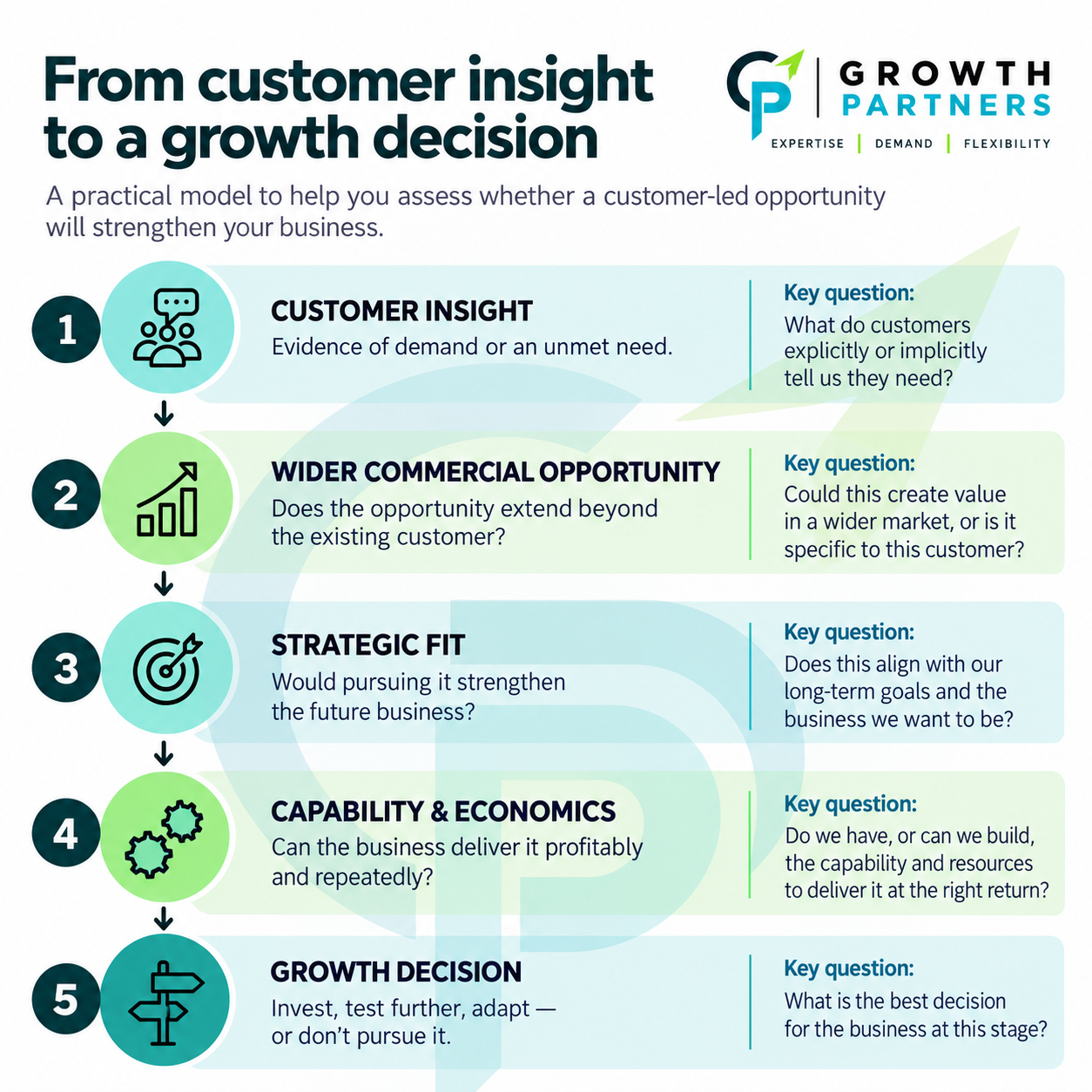
Where should customer insight sit in a growth decision?
Customer insight is useful because it provides evidence, but that evidence still needs to pass through a commercial and strategic assessment before it becomes an investment decision. DBS Bank provides an interesting example of a structural response. As part of its wider transformation, the bank introduced Managing Through Journeys, organising responsibility around complete customer journeys rather than allowing the outcome to emerge from separate decisions across the organisation.
By 2024, DBS had more than 60 customer journeys operating in this way, collectively accounting for more than 60% of the bank's revenue.
An SME clearly doesn't need the organisational structure of a major bank, but the underlying problem appears much earlier in a company's development. As responsibility becomes distributed across a growing organisation, customer insight needs to reach the people able to assess its commercial value and commit the resources required to act on it.
So, should customers lead your growth?
Customer insight is most useful when it changes what a business knows, rather than automatically changing what it does.
Existing customers can provide strong evidence of an opportunity, but management still has to consider whether pursuing it will strengthen the business it is trying to build. Additional revenue isn't necessarily evidence of successful growth if delivering it creates disproportionate cost, complexity or capability requirements.
The strongest growth decisions combine customer evidence with a clear understanding of where the business intends to compete and the capability it will need to get there.
Customers can provide some of the best evidence an SME has about where an opportunity may exist. Deciding whether that opportunity is worth building a business around remains a management decision.
5 key findings
- Customer demand can identify growth opportunities. Repeated customer needs can provide evidence of a market opportunity that may not have emerged through internal planning.
- Your existing customers represent your current market. Future growth may come from customers, markets or capabilities that sit outside the business you serve today.
- More revenue doesn't always create a stronger business. Responding to individual customer requirements can add cost and complexity without creating capability that can be used elsewhere.
- Customer insight becomes harder to act on as a business grows. The need may be understood clearly, while the decisions and resources required to respond increasingly sit across different parts of the organisation.
- Customer evidence should inform strategy, not replace it. Management still has to decide whether an opportunity is commercially attractive, strategically relevant and worth developing the capability to pursue.
Growth Partners Group
Specialist capability for growing businesses.