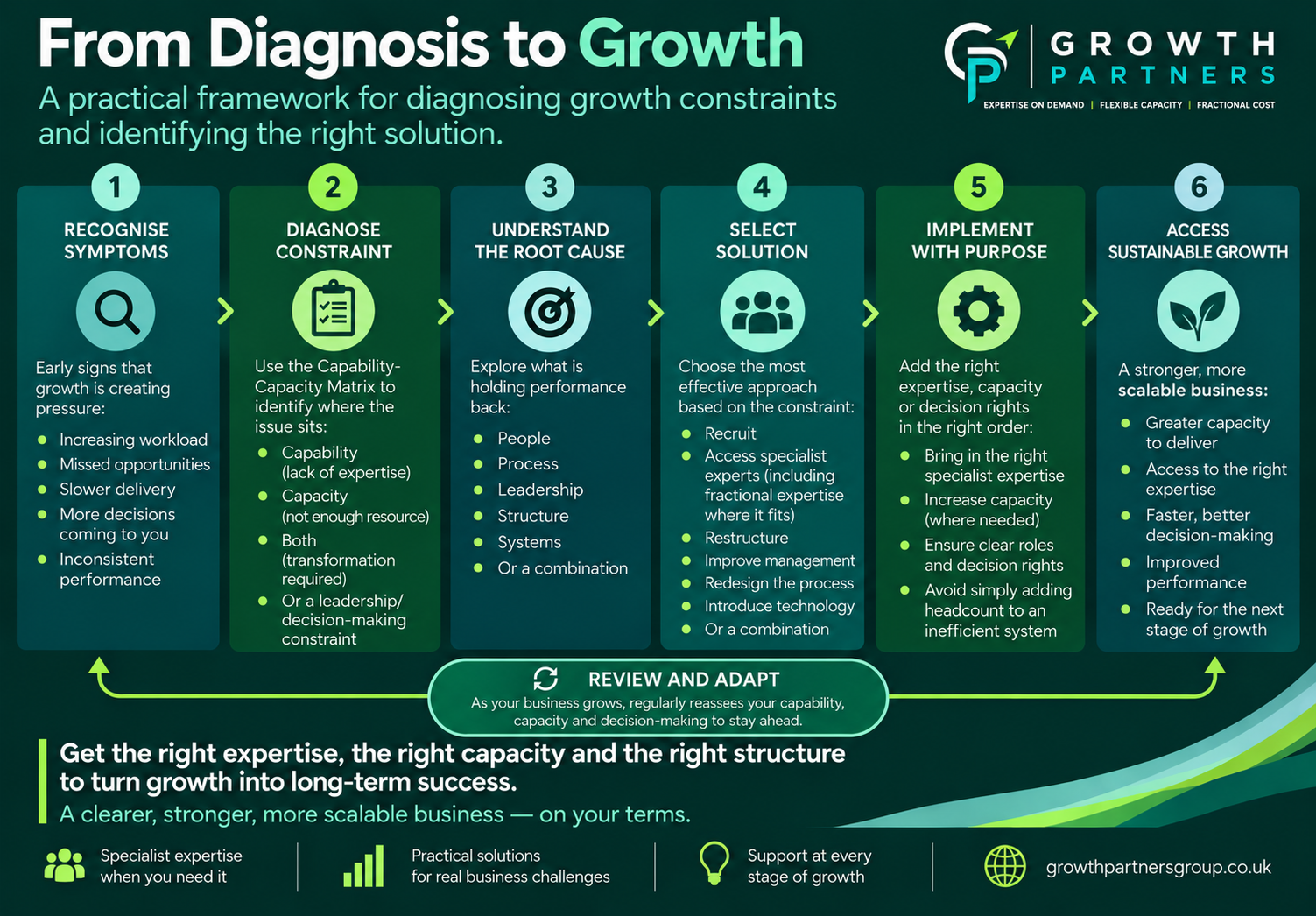
Does a growing business need more people or different expertise?
If the business already knows what needs to be done and has the expertise to do it well, but cannot execute enough of it, the constraint is principally capacity. If the people and time exist but the specialist knowledge, experience or judgement is missing, the constraint is capability. Where both appear adequate but performance is still weak, the cause may sit in leadership, decision-making, process or organisational design.
When a growing business begins to struggle with workload, missed opportunities or slower delivery, the obvious explanation is often that it needs more people. Growth can expose several quite different constraints, and they can look remarkably similar from the outside. A team may genuinely have insufficient capacity, it may be missing a particular capability, senior managers may be absorbing decisions that should sit elsewhere, or the operating model itself may simply no longer be appropriate for the size and complexity of the organisation.
The distinction matters because each problem requires a different response. If the business already knows what needs to be done and has the expertise to do it well, but cannot execute enough of it, the issue is principally one of capacity. If the people and time exist but the organisation lacks the specialist knowledge, experience or judgement required to achieve the outcome, the issue is capability. Where both appear adequate but performance is still constrained, the problem may lie in leadership, decision-making, process or organisational design.
The GPG Capability–Capacity Matrix
A useful first diagnostic is to separate the amount of resource available from the quality of expertise available.
| Sufficient capacity | Insufficient capacity | |
|---|---|---|
| Sufficient capability | Execution zone — the organisation appears to have both the knowledge and resource required. If results remain weak, look at process, accountability, leadership or decision-making. | Capacity constraint — the organisation knows how to produce the result but cannot execute enough of the work. |
| Insufficient capability | Capability constraint — there may be enough people, but the required specialist knowledge or judgement is missing. | Transformation constraint — the business needs both additional expertise and additional execution capacity. |
The value of the matrix is not that every business problem will fit neatly into one box. It is that it forces management to distinguish between fundamentally different uses of investment.
A capacity constraint is essentially a volume problem. The business has a proven sales process but too few people to follow up every opportunity; the marketing strategy is sound but the team does not have the time to implement it; or operational demand has increased faster than the resource available to fulfil it. In these circumstances, increasing capacity through recruitment, outsourcing, technology or process improvement may be rational because the organisation already understands how the additional resource will create value.
A capability constraint is different. Here the business may be busy and well staffed, but it lacks the experience required to make a particular transition. Perhaps no one has built a scalable sales function before, managed a significant restructuring, developed a funding strategy or introduced a new management discipline. Adding more general resource does not necessarily solve that problem because the organisation is not short of effort; it is short of a particular form of expertise.
The most challenging position is the transformation constraint, where capability and capacity are both insufficient. A founder-led sales operation, for example, may need a senior commercial specialist to design the future sales model while simultaneously requiring additional people, processes and systems to execute it. Simply recruiting more salespeople into the existing structure could increase cost without removing the original constraint.
Why growing businesses frequently misdiagnose the problem
Capacity and capability problems generate many of the same symptoms. People become over-worked, deadlines move, opportunities are missed, managers become more involved in day-to-day work and customers begin to experience inconsistency. None of those symptoms, however, proves that the organisation needs more people.
Consider two businesses experiencing disappointing marketing performance.
The first has a clear proposition, understands its target market and can demonstrate that its campaigns generate commercially useful enquiries. The problem is execution: one person is trying to deliver an amount of activity that now exceeds the realistic capacity of the role. Additional resource could increase output because the business already knows what successful marketing looks like.
The second business has several people producing content, running campaigns and attending events, but nobody can clearly explain which customer segments matter most, how the proposition should be differentiated or how marketing activity connects to commercial priorities. Increasing headcount may increase activity, but it is unlikely to improve performance until the strategic capability is strengthened.
The visible symptom is the same: marketing is not producing enough. It’s time to ask: What result are we trying to produce, what is constraining that result, and what type of resource would remove that constraint?
The competent resource test
One simple way of testing the distinction is to imagine that the business receives an additional 20 hours of competent resource every week at no cost.
Would the management team know precisely how to deploy those hours, what work should be done and what successful execution would look like?
If the answer is yes, there is strong evidence of a capacity constraint. The organisation understands the required outcome and possesses the necessary capability; it simply cannot execute enough of the work.
If the answer is no because the organisation is still unclear about the right strategy, structure, process or technical solution, additional hours alone will not resolve the problem. That points towards a capability constraint.
There is, however, a third answer which is particularly common in owner-managed businesses: “Yes, but everything would still need to come back to me.”
That indicates a different form of constraint.
When the scarce resource is senior attention
As organisations grow, the founder or senior management team can become the hidden bottleneck even when overall headcount is increasing.
Centralised decision-making is often highly effective in the early stages of a business. The founder understands the customers, proposition, employees and commercial priorities and can make decisions quickly. As the organisation grows, however, the volume and complexity of decisions increase faster than the amount of senior management time available to make them.
This creates an interesting but common management problem. The business may respond to overload by recruiting more people, but every additional employee can also generate further communication, supervision, exceptions and decisions. If authority remains concentrated at the top, increasing operational capacity can actually increase pressure on the organisation's most constrained resource: senior attention.
The capacity–capability framework therefore needs a third dimension: authority.
The GPG Three-Resource Model
A growing business needs all three. It requires sufficient expertise to make good decisions, sufficient capacity to execute those decisions and an organisational structure that allows decisions to be taken at an appropriate level.
A deficit in any one of the three can create the appearance of overload.
Recruitment should follow diagnosis, not precede it
Once the constraint has been identified, the question of recruitment becomes more rational.
Permanent recruitment is generally most compelling where the requirement is ongoing, predictable and sufficiently utilised to justify placing the capability permanently inside the organisation. A growing company that genuinely needs a finance manager five days a week for the foreseeable future is dealing with a very different economic decision from a company that needs experienced financial leadership for perhaps two or three days each month.
The same distinction applies across sales, marketing, HR, operations and technology.
This leads to another useful management distinction: ownership of capability versus access to capability.
Recruitment gives the organisation ownership of the resource. Fractional or specialist support gives the organisation access to capability without necessarily carrying the full fixed cost of employing it continuously.
Neither model is inherently superior. The correct decision depends on the nature of the requirement.
The GPG Capability Sourcing Model
| Requirement | More likely response |
|---|---|
| Permanent, predictable and highly utilised | Permanent recruitment solution |
| Specialist and important, but required intermittently | Fractional or specialist expertise may be more efficient |
| Known work with insufficient execution resource | Additional delivery capacity required |
| Unclear solution requiring senior judgement first | Expertise resource should precede additional capacity |
| Existing team capable but decisions remain centralised | Leadership structure and decision rights need attention |
| Existing process is inefficient | Redesign the process before adding headcount |
The practical implication is important. A business does not necessarily need to employ every capability it requires in order to have reliable access to it.
For a growing SME, that can significantly change the economics of accessing senior expertise.
The sequencing problem
The order in which resource is added matters almost as much as the resource itself.
Where the underlying operating model is weak, adding capacity first can simply allow an inefficient system to operate at greater scale. Where expertise is missing, the more logical sequence may be to introduce the specialist capability required to design the solution, determine the appropriate structure and only then decide how much execution capacity is necessary.
That principle can be expressed simply:
Businesses frequently reverse the middle two stages. They add resource and hope the additional person will determine how the work should be organised once they arrive.
Sometimes that succeeds, but it can also create another role inside a system whose underlying problem has still not been addressed.
Four questions management should answer before increasing headcount
Before deciding whether recruitment is the solution, a management team should be able to reach a reasonably clear view on four issues: whether the desired outcome is understood; whether the necessary expertise already exists inside the organisation; whether sufficient capacity exists to execute the work; and whether decision-making authority sits at the level required for that resource to operate effectively.
Together, those questions create a much stronger basis for deciding between recruitment, fractional expertise, specialist suppliers, outsourcing, technology, process redesign or some combination of them.
They also make the commercial case for additional resource easier to assess because the business can identify which constraint the investment is expected to remove.
The management question to answer first
Growth creates more work and changes the nature of the organisation:
More customers increase delivery complexity. More employees increase management requirements. Larger contracts introduce different commercial risks. New markets demand different expertise. Greater scale places more pressure on systems, processes and decision-making.
The capabilities that took a business successfully through one stage of growth are therefore not automatically the capabilities required for the next.
Before creating another role, ask this question:
If we added this person or this expertise tomorrow, precisely which constraint would it remove?
If the answer is clear, the business is in a much stronger position to decide how that capability should be sourced.
If the answer is not yet clear, recruitment may still prove to be the right decision — but the diagnosis is not finished.